Delicious Looking Problem | 0xFun CTF 2026
a writeup for "Delicious Looking Problem" in 0xFun CTF 2026.


Overview
- Platform: 0xFun
- Challenge: Delicious Looking Problem
- Categories: Crypto
- Rating: /10
- Difficulty: Medium
- Sovling Time: ~30 Minutes
Challenge
“A delicious looking problem for starters. Always remember that the answer to life, universe and everything is 42.
Have fun:3”
Walkthrough
Recon
If we look into the provided code we can see that it uses only 42 bit long primes (2^42) which is pretty small for AES and can be Bruteforced pretty quick….
The Code
1
2
3
4
5
6
7
8
9
10
11
12
13
14
15
16
17
18
19
20
21
22
23
24
25
26
27
28
29
30
31
32
33
34
35
36
37
38
39
40
41
42
43
from Crypto.Util.number import *
from Crypto.Cipher import AES
from Crypto.Util.Padding import pad
from random import getrandbits
import hashlib
import os

flag = b'redacted'
key = os.urandom(len(flag))
Max_sample = 67 # :3

def get_safe_prime(bits):
    while True:
        q = getPrime(bits-1)
        p = 2*q + 1
        if isPrime(p):
            return p, q

def primitive_root(p, q):
    while True:
        g = getRandomRange(3, p-1)
        if pow(g, 2, p) != 1 and pow(g, q, p) != 1:
            return g

def gen():
    p, q = get_safe_prime(42)   # Should've chosen a bigger prime, but got biased:3 [https://www.youtube.com/watch?v=aboZctrHfK8]
    g = primitive_root(p, q)
    h = pow(g, bytes_to_long(key), p)

    return g, h, p

Max_samples = Max_sample//8 # Can't give you that many samples:3
with open('output.txt', 'w') as f:
    for i in range(Max_samples):
        g, h, p = gen()
        f.write(f'sample #{i+1}:\n')
        f.write(f'{g = }\n')
        f.write(f'{h = }\n')
        f.write(f'{p = }\n')

    cipher = AES.new(hashlib.sha256(key).digest(), AES.MODE_ECB)
    ct = cipher.encrypt(pad(flag, 16)).hex()
    f.write(f'{ct = }')
Solution Approach
“Flag format:
0xfun{}”
This challenge is a classic case of a “Broken Math Lock.” While the encryption used is AES-256 (which is super strong), the secret password used to generate the AES key is hidden behind some very weak math, Yes weaker than Van der Waals force bond.
The Math Lock (DLP)
The script uses the Discrete Logarithm Problem (DLP). In high level crypto, this is a one-way street, it’s easy to calculate \(g^{x} (mod\ \rho)\) but nearly impossible to go backward and find .However, the security of this “lock” depends entirely on the size of the prime number \(\rho\) .Standard Primes: 2048 bits (unhackable). This Challenge: 42 bits. Because 42 bits is so small (roughly 13 digits), a modern computer doesn’t even break a sweat. It can “brute force” the math or use smart algorithms like Baby-step Giant-step (BSGS) to find the secret exponent \(x\) in less than a second.
Piecing the Puzzle (CRT)
The secret key used in the script is about 43 bytes long (~344 bits), which is way bigger than our 42-bit prime. This is why we have 8 samples. Each sample gives us a tiny piece of the secret. We can use the Chinese Remainder Theorem (CRT) to stitch those 8 pieces together. It’s like having 8 different “clocks” all running at different speeds; by looking at where the hands are on all of them, we can calculate the exact time the master clock started.
The Final Step
Even after using CRT, we might be off by a tiny bit because the key could be slightly larger than our combined math result. We run a small loop to check the last few possibilities:
- Take the candidate key.
- Hash it with SHA-256 to get the actual AES key.
- Try to decrypt the AES-ECB ciphertext.
- If the output looks like a flag (starts with 0xFun{}), we’ve won!
Solving Code
1
2
3
4
5
6
7
8
9
10
11
12
13
14
15
16
17
18
19
20
21
22
23
24
25
26
27
28
29
30
31
32
33
34
35
36
37
38
39
40
41
42
43
44
45
46
47
48
49
50
51
52
53
54
55
56
57
58
59
60
61
62
63
64
65
66
67
68
69
70
71
72
73
74
75
76
77
78
79
80
81
82
83
84
85
86
87
88
89
90
91
92
93
94
95
96
97
98
99
100
101
102
103
104
105
106
107
from sympy.ntheory import discrete_log
from cryptography.hazmat.primitives.ciphers import Cipher, algorithms, modes
from math import gcd, lcm
from functools import reduce
import hashlib

# ── Data ──────────────────────────────────────────────────────────────────────
samples = [
    dict(g=227293414901,  h=1559214942312, p=3513364021163),
    dict(g=2108076514529, h=1231299005176, p=2627609083643),
    dict(g=1752240335858, h=1138499826278, p=2917520243087),
    dict(g=1564551923739, h=283918762399,  p=2602533803279),
    dict(g=1809320390770, h=700655135118,  p=2431482961679),
    dict(g=1662077312271, h=354214090383,  p=2820691962743),
    dict(g=474213905602,  h=1149389382916, p=3525049671887),
    dict(g=2013522313912, h=2559608094485, p=2679851241659),
]
ct = bytes.fromhex(
    '175a6f682303e313e7cae01f4579702ae6885644d46c15747c39b85e5a1fab66'
    '7d2be070d383268d23a6387a4b3ec791'
)

# ── Step 1: Solve DLP in each small group ────────────────────────────────────
# p is 42-bit safe prime (p = 2q+1, q 41-bit prime)
# g is a primitive root → order = p-1 = 2q
# DLP gives key_int ≡ x_i  (mod p_i - 1)
print("[*] Solving discrete logs (42-bit primes, trivial BSGS)...")
residues, moduli = [], []
for i, s in enumerate(samples):
    g, h, p = s['g'], s['h'], s['p']
    x = discrete_log(p, h, g)
    assert pow(g, x, p) == h, "DLP sanity check failed"
    print(f"  sample #{i+1}: key_int ≡ {x}  (mod {p-1})")
    residues.append(x)
    moduli.append(p - 1)

# ── Step 2: Generalised CRT (moduli share factor 2) ──────────────────────────
def extended_gcd(a, b):
    if b == 0: return a, 1, 0
    g2, x2, y2 = extended_gcd(b, a % b)
    return g2, y2, x2 - (a // b) * y2

def modinv(a, mod):
    _, x, _ = extended_gcd(a % mod, mod)
    return x % mod

def generalised_crt(residues, moduli):
    x, m = residues[0], moduli[0]
    for r, n in zip(residues[1:], moduli[1:]):
        g = gcd(m, n)
        assert (r - x) % g == 0, "Inconsistent system"
        inv = modinv(m // g, n // g)
        x = x + m * (((r - x) // g) * inv % (n // g))
        m = m * n // g
        x %= m
    return x, m

print("\n[*] Running generalised CRT...")
key_val, combined_mod = generalised_crt(residues, moduli)
assert combined_mod == reduce(lcm, moduli), "CRT modulus ≠ LCM sanity check"
print(f"  key_int ≡ key_val  (mod combined_mod)")
print(f"  key_val   = {key_val}  ({key_val.bit_length()} bits)")
print(f"  combined_mod bits = {combined_mod.bit_length()}")

# ── Step 3: AES helpers ──────────────────────────────────────────────────────
def aes_ecb_decrypt(key32, ct):
    cipher = Cipher(algorithms.AES(key32), modes.ECB())
    dec = cipher.decryptor()
    return dec.update(ct) + dec.finalize()

def unpad_pkcs7(data):
    pad_len = data[-1]
    if pad_len == 0 or pad_len > 16:
        raise ValueError("bad padding")
    if data[-pad_len:] != bytes([pad_len] * pad_len):
        raise ValueError("bad padding")
    return data[:-pad_len]

# ── Step 4: Brute-force over residue class ───────────────────────────────────
# AES-ECB ciphertext = 48 bytes  →  flag = 33..47 bytes (PKCS7)
# key_val is 324 bits; minimum key_len to hold it = 41 bytes.
# For key_len = 43: ~1 million candidates, trivially feasible.
print("\n[*] Searching residue class for correct key (key_len=43, ~1M candidates)...")
key_len = 43
max_val = 1 << (key_len * 8)
c = key_val
cnt = 0
flag = None

while c < max_val:
    kb = c.to_bytes(key_len, 'big')
    digest = hashlib.sha256(kb).digest()
    raw = aes_ecb_decrypt(digest, ct)
    try:
        pt = unpad_pkcs7(raw)
        if all(32 <= b < 127 for b in pt):
            flag = pt.decode()
            print(f"\n[+] FLAG: {flag}")
            break
    except Exception:
        pass
    c += combined_mod
    cnt += 1

if flag is None:
    print("Not found in key_len=43, try expanding the search.")
print(f"\n[*] Checked {cnt:,} candidates.")
And there we got the flag! 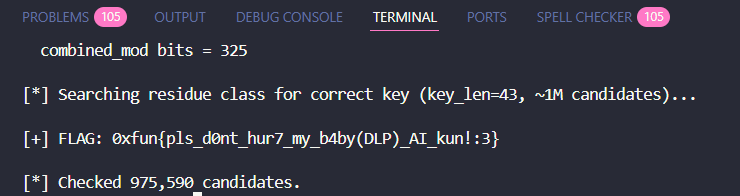
Flag
0xfun{pls_d0nt_hur7_my_b4by(DLP)_AI_kun!:3}
Hope you enjoined the writeup, Don’t forget to leave a comment or a star on the github repo (;